How to Shift Your Bedtime Without Lying Awake for a Week
Quick Answer: Do not move bedtime first - move your wake time and your morning light exposure first, and let sleep pressure pull bedtime earlier on its own. Shift in increments of 15 to 20 minutes every two to three days rather than in one jump, keep the wake time fixed including weekends, get outdoor light within an hour of waking, and dim indoor light in the two hours before your target bedtime. Lying in bed earlier without these changes just teaches your brain that bed is a place you are awake.
You decided to start going to bed at ten.
And spent five nights staring at the ceiling until midnight, tired and slightly annoyed about it.

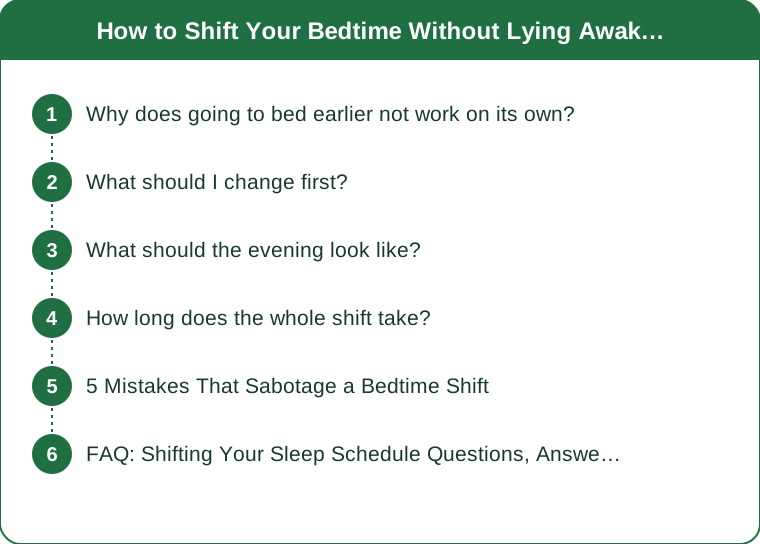
Why does going to bed earlier not work on its own?
Because sleep timing is governed by two systems, and only one of them responds to a decision.
Sleep pressure builds the longer you are awake, and it is what makes you sleepy. If you get into bed two hours earlier, you simply have two hours less pressure.
Circadian timing decides when your body expects to sleep, and it is set primarily by light exposure - not by intention or by what time you get into bed.
Getting into bed before either system is ready produces wakefulness, and repeated wakefulness in bed weakens the association between bed and sleep, which is a well-recognised mechanism in insomnia.
Which means the earlier bedtime is the last thing to change, not the first.
Change the inputs and the bedtime follows. This is general information, not medical advice.
What should I change first?
The wake time. It is the most powerful lever available and the one under the most direct control, because you can set an alarm and you cannot set a fall-asleep.
Move it earlier by 15 to 20 minutes and hold it for two to three days before moving again. Larger jumps produce a sleep-deprived week rather than a shifted schedule.
Hold it on weekends too, at least during the shift. A two-hour weekend lie-in undoes several days of adjustment - this is sometimes described as social jet lag.
Get outdoor light within an hour of waking, for 10 to 30 minutes. Outdoor light is dramatically brighter than indoor light even on an overcast day, and morning light exposure is one of the most robust ways to advance circadian timing.
Do not nap during the shift, because naps reduce the sleep pressure you need in the evening.
Expect to feel tired for the first few days. That tiredness is the mechanism working, not a sign of failure.
What should the evening look like?
Dim the lights two hours before your target bedtime, which matters more than most people expect - bright evening light delays circadian timing directly.
Lower the overhead lights and use lamps. This costs nothing and is more effective than most sleep products.
Screens matter mainly for their brightness and for what you are doing on them. A dim screen at arm’s length is a smaller problem than a stimulating conversation or a work email at 10pm.
Keep the last hour boring on purpose. Predictable and low-stimulation, same sequence each night, so it becomes a cue.
Get into bed when sleepy, not when the clock says so during the shift period - this preserves the bed-sleep association.
And if you are awake for more than about 20 minutes, get up. Read something dull in dim light and return when sleepy. This is standard practice in behavioural sleep approaches. This is general information, not medical advice.

How long does the whole shift take?
Roughly a week for a 30 to 45 minute shift, and two to three weeks for a full 90 minutes or more.
Advancing sleep - going earlier - is harder than delaying it, which is why staying up late is easy and going to bed early is not. Most people’s internal rhythm runs slightly longer than 24 hours, which biases toward later.
The morning light is doing the heaviest lifting and is the step most often skipped, so if the shift stalls, that is the first thing to check.
Consistency matters more than perfection. One late night in a fortnight is fine; three per week means you are not shifting, you are oscillating.
The wake time locks in before the bedtime does, so do not judge progress by how easily you fall asleep in week one.
And late summer into autumn is the easiest time of year to do this, because sunrise is getting later, which naturally supports an earlier schedule if you are outside for it.
5 Mistakes That Sabotage a Bedtime Shift
1. Moving bedtime before wake time. The most common error and the reason most attempts fail in week one. Sleep pressure has to build; you cannot decide your way into sleepiness.
2. Weekend lie-ins during the shift. Two hours extra on Saturday and Sunday resets your body clock later, and Monday feels like jet lag because functionally it is.
3. Napping to cope with the tiredness. Understandable and counterproductive - the afternoon nap is borrowing exactly the sleep pressure you need at 10pm.
4. Skipping the morning light because it is cloudy. Overcast outdoor light is still far brighter than a well-lit room. Ten minutes outside beats an hour under ceiling lights.
5. Lying in bed awake trying harder. Effort is arousing, and the more time you spend awake in bed the weaker the bed-sleep association becomes. Get up, do something dull, come back.
And the bonus one: changing five things at once. Bedtime, caffeine, alcohol, a new mattress and a supplement all in the same week means you learn nothing about what worked.
FAQ: Shifting Your Sleep Schedule Questions, Answered
How much can I shift at once?
15 to 20 minutes every two to three days is a well-tolerated pace. Faster is possible but usually produces enough sleep debt that people abandon it.
Does melatonin help with shifting?
Low-dose melatonin taken several hours before target bedtime is used specifically for circadian shifting rather than as a sleeping tablet, and timing matters more than dose. Discuss it with a pharmacist or healthcare professional before starting. This is general information, not medical advice.
What if I have to wake early for work but cannot fall asleep early?
That gap is the definition of the problem and the fix is the same: fixed early wake time, morning outdoor light, no naps, dim evenings. It usually takes two to three weeks rather than a few days.
Do blue light glasses work?
Evidence is mixed and generally weaker than the marketing suggests. Reducing overall evening light levels is better supported and cheaper.
Is caffeine the problem?
Often a contributor. Caffeine has a half-life of several hours, so an afternoon coffee is still meaningfully present at bedtime for many people. Try moving your last one to before noon during a shift.
When should I see a professional?
If you consistently cannot sleep despite good habits, if you wake unrefreshed regardless of duration, if you snore heavily or stop breathing in your sleep, or if sleep problems affect your daytime functioning. This is general information, not medical advice.
TL;DR:
- Move your wake time first and let sleep pressure pull bedtime earlier.
- Shift 15 to 20 minutes every two to three days, not all at once.
- Outdoor light within an hour of waking is the strongest lever and the most skipped step.
- Hold the wake time on weekends during the shift, or you reset it every Saturday.
- Dim indoor lights two hours before target bedtime.
- If you are awake more than 20 minutes, get up rather than trying harder.
You cannot decide to be sleepy, but you can change everything that makes you sleepy. This is general information, not medical advice.
Keep Reading
This article is for general informational purposes only and is not medical advice. Always consult a qualified health professional for guidance specific to you.