Why Reading in Bed Helps Some People and Wrecks It for Others
Quick Answer: Reading in bed helps when it lowers arousal and occupies attention just enough to stop rumination. It backfires when the material is engaging enough to raise arousal, or when it trains your brain to associate the bed with being awake and alert. The deciding factors are the content, the format and how long you stay — not whether you read at all. If you regularly read past the point of feeling sleepy, the habit is working against you.
The advice given to everyone is the problem.
The same twenty minutes can be the best or worst part of your evening depending on three variables you control.

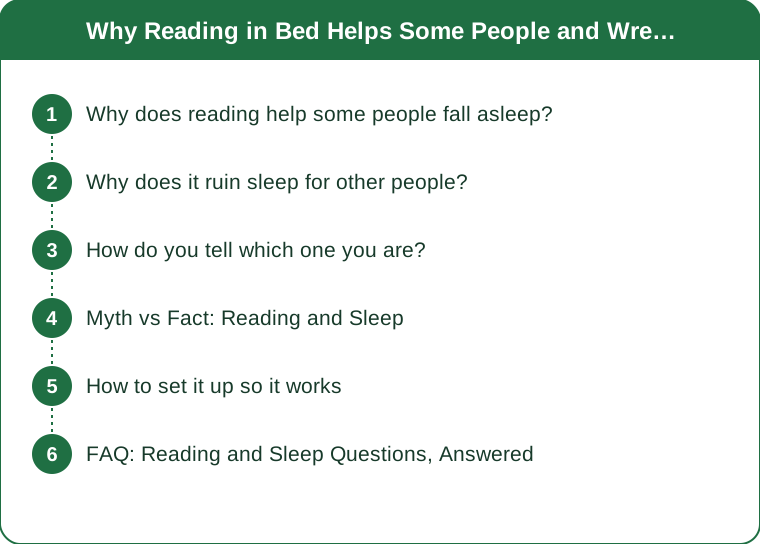
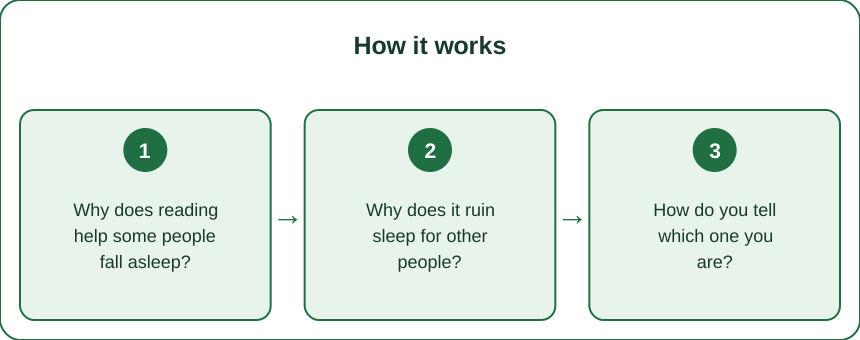
Why does reading help some people fall asleep?
Because falling asleep requires two things at once, and reading can supply both.
The first is reduced physiological arousal — heart rate down, muscles relaxed, stress hormones on their evening decline. Lying still with a book supports this simply by being still and quiet in dim light.
The second, and the one people underestimate, is somewhere for your attention to go. A very large share of difficulty falling asleep is not physical at all. It is a mind that has finally been left alone with the day, and starts working through it.
Reading occupies that channel. Not fully — you are not solving problems — but enough that the rumination loop cannot get started. This is the same mechanism behind why some people fall asleep to podcasts or audiobooks.
There is also a conditioning effect. A stable, repeated pre-sleep routine becomes a cue in itself, and cues matter. Doing the same low-key thing at the same time in the same light tells your system what comes next.
So for someone whose main obstacle is a busy head, reading is close to ideal — it is quiet, dim, still, and it gives attention a low-demand place to rest.
Why does it ruin sleep for other people?
Two distinct failure modes, and they need different fixes.
Failure mode one: the material is too good. A gripping plot, an unresolved chapter ending, or anything that produces a genuine emotional response raises arousal rather than lowering it. Suspense in particular is arousing by design — that is what the writer is doing. Reading a thriller as a wind-down is asking a device built to keep you awake to put you to sleep.
The tell is easy to spot: if you have ever said “one more chapter” out loud, you have identified your own failure mode.
Failure mode two: the bed becomes an awake place. This is the more insidious one. A central principle in the behavioural treatment of insomnia is stimulus control — keeping the bed associated with sleep and very little else. Every hour spent awake and alert in bed weakens that association.
For someone who falls asleep easily, this costs nothing. For someone who already lies awake, it makes the bed a place where lying awake is normal, which is precisely the association you are trying to break.
There is a third, smaller factor: light. A bright overhead light or a backlit screen at close range gives your system a signal that contradicts everything else about the routine. This is usually a smaller effect than people believe, but at close distance and full brightness it is not nothing.
How do you tell which one you are?
Three questions, honestly answered. This takes about a minute and it is more useful than any general rule.
Do you stop when you feel sleepy, or do you push past it? The single strongest predictor. Reading until sleepy and then stopping is a wind-down. Reading past sleepy is an activity, and pushing through the first wave of sleepiness typically means waiting for the next cycle — often forty to ninety minutes later.
Does your reading time vary a lot? Twenty minutes every night is a routine. Fifteen minutes on Monday and ninety on Thursday means the book is driving, not the routine.
Do you already have trouble sleeping? If you fall asleep within twenty minutes most nights, stimulus control is not your issue and you can read in bed freely. If you regularly lie awake, the bed association matters and reading in bed is working against you even if it feels calming.
The combined answer is usually obvious once you look at it. Most people who suspect reading is hurting their sleep are right, and most who have never wondered are fine.
One more check with a seasonal edge: as evenings get darker earlier, the natural cue to start winding down arrives sooner while the clock does not move. Many people find their reading window stretches without noticing in autumn, which turns a twenty-minute routine into a forty-minute one at the same bedtime.

Myth vs Fact: Reading and Sleep
Myth: Paper books are always better than e-readers for sleep.
Fact: The format matters less than the brightness and the content. A dedicated e-reader on a low warm setting is very close to paper in effect. A phone at full brightness at 20cm is a different proposition — but mostly because of what is on the phone rather than the light itself.
Myth: Any reading counts as winding down.
Fact: Content matters enormously. Work material, news, and anything emotionally activating all raise arousal. Reading is a delivery mechanism, not an intervention in itself.
Myth: If reading makes you sleepy, you should keep going until you drop off.
Fact: Falling asleep mid-page is fine if it happens, but deliberately pushing to that point often means overshooting the sleepy window. Stopping when you first notice sleepiness is more reliable.
Myth: Reading in bed is bad sleep hygiene, full stop.
Fact: This is over-applied advice from insomnia treatment protocols. Stimulus control is a genuinely effective treatment for people with insomnia. For good sleepers it is unnecessary restriction.
Myth: You should read something boring.
Fact: This is the advice everyone gives and it is subtly wrong — something genuinely boring lets your mind wander straight back to whatever it was ruminating about. You want mildly interesting: engaging enough to hold attention, not engaging enough to demand it. Familiar re-reads are close to perfect for this reason.
How to set it up so it works
Six adjustments, in order of impact.
1. Choose the content deliberately. Mildly interesting, not gripping. Non-fiction you are curious but not urgent about, essays, short pieces, or a book you have read before. Avoid anything with a cliffhanger structure. This is the highest-leverage change and it costs nothing.
2. Set an end condition that is not the chapter. Chapters are designed to pull you forward. Use a time, a page count, or the first yawn — anything that is not decided by the author.
3. Read somewhere else if you sleep badly. A chair in the bedroom, ten minutes, then into bed. This preserves the wind-down and protects the bed association, and it is the standard recommendation for anyone with insomnia symptoms.
4. Get the light right. One warm, dim source, positioned so it lights the page rather than the room. Bright overhead light is the version most likely to interfere.
5. Keep the duration stable. Twenty minutes most nights beats a range of ten to ninety. Consistency is doing more work here than the reading is.
6. Stop at the first genuine yawn. Not the second, not the end of the page. The sleepy window is real and it closes.
If you regularly take more than thirty minutes to fall asleep, wake repeatedly, or feel unrefreshed despite adequate time in bed, that is worth raising with a GP — persistent insomnia responds well to proper treatment and is not a habit problem. This is general information, not medical advice.
FAQ: Reading and Sleep Questions, Answered
Is an e-reader really fine?
On a dedicated device with a warm, dim front light, yes — the difference from paper is small. The real advantage of paper is that it cannot notify you, which for many people is the whole story.
What about audiobooks or podcasts?
They work on the same principle and suit people who find holding a book too physically engaging. The same content rule applies, and a sleep timer is essential — otherwise the material keeps playing into light sleep, which fragments it.
How long should I read for?
Most people land somewhere between fifteen and thirty minutes. What matters more than the number is that it is roughly the same every night and that it ends when you feel sleepy rather than when the section does.
I fall asleep reading and wake at 3am with the light on. Is that a problem?
The waking is usually a normal end-of-cycle awakening that you notice because the light and the book are there. Use a bedside lamp with a timer, or read for a set period and then turn the light off deliberately.
Does it matter what time I read?
Less than the consistency does. If your bedtime shifts around, anchoring the reading to the bedtime rather than the clock keeps the cue meaningful.
Can I read to my kids in their bed and count that as my wind-down?
Not really — it is usually more social and more alerting than a solo read, and it typically finishes some time before you go to bed yourself. Enjoyable, but it is a different activity.
TL;DR:
- Reading helps by lowering arousal and giving attention somewhere to go instead of ruminating
- It backfires when the content is gripping, or when it trains the bed as a place you are awake
- If you already lie awake at night, read in a chair rather than in bed — the association matters
- Choose mildly interesting over boring; boring lets your mind wander back to the day
- Stop at the first genuine yawn, and use a timer or page count rather than the chapter as your end point
Swap the thriller for something you have already read, set a twenty-minute limit, and stop at the first yawn for a week. If nothing changes, reading was never your problem — which is worth knowing too.
Keep Reading
This article is for general informational purposes only and is not medical advice. Always consult a qualified health professional for guidance specific to you.