Does a Fan Actually Help You Sleep, or Does It Just Feel Cooler?
Quick Answer: A fan does not cool a room - the motor actually adds a small amount of heat. What it does is move air across your skin, which speeds up evaporation and convection so your body sheds heat faster. Since falling asleep depends on your core temperature dropping, that faster heat loss genuinely helps you fall asleep - but only if the air is reaching skin, not blankets. Point it at your upper body and leave your feet and hands uncovered.
Your thermostat and your skin disagree about what temperature the room is.
Only one of them controls whether you fall asleep.
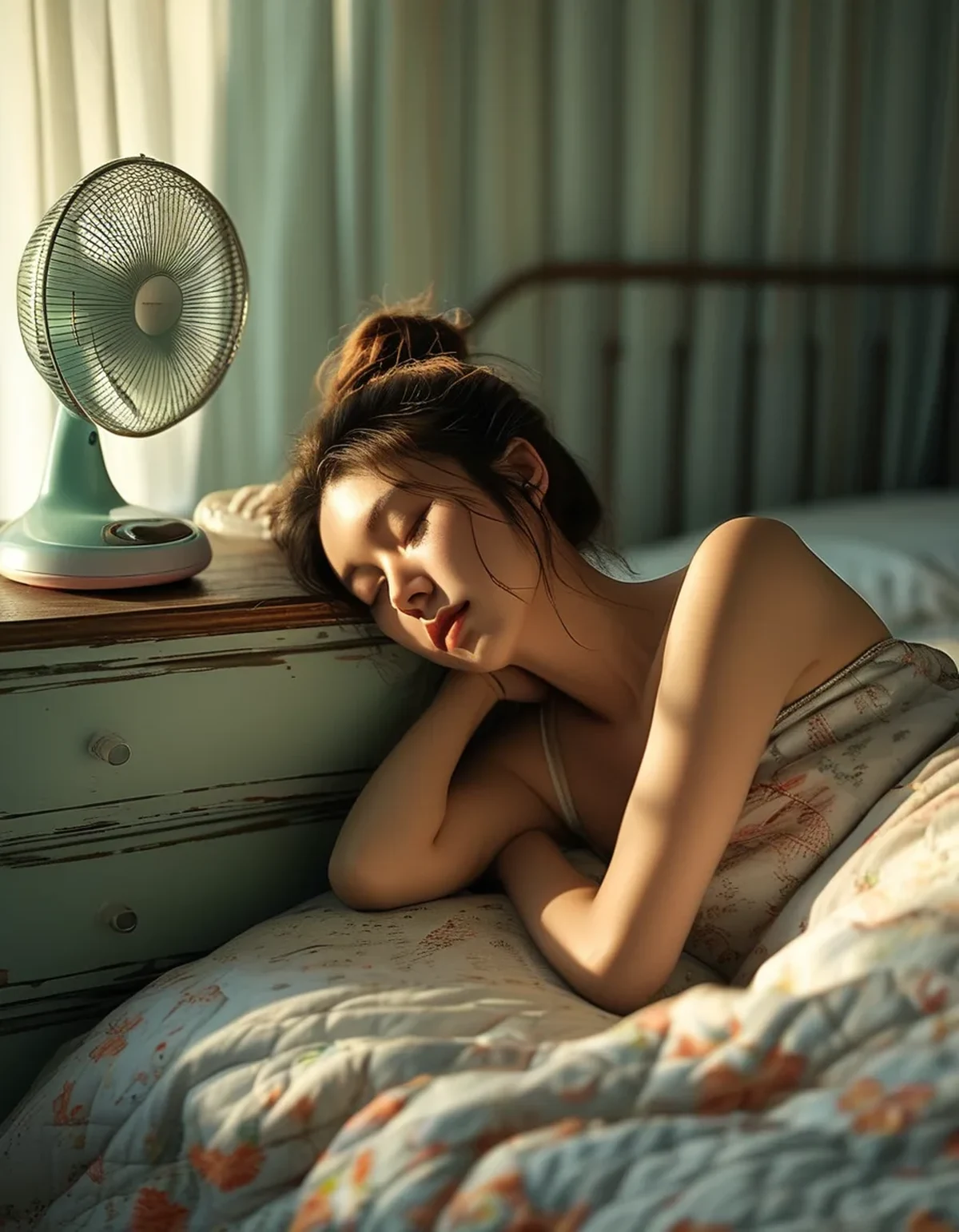
How does a fan help if it does not cool the room?
It changes how fast your body loses heat, which is a completely different thing from changing the air temperature.
Your body sheds heat in four ways, and a fan boosts two of them. Moving air carries warm air away from your skin faster (convection) and speeds the evaporation of sweat you may not even notice you have (evaporation). Both remove heat from you without changing the number on the thermostat.
Falling asleep requires a drop in core body temperature. Your core temperature naturally falls in the hour or two before sleep, and that fall is part of the signal that starts sleep. Anything that helps you dump heat helps that signal arrive on time. Anything that traps heat delays it.
This is why the same room can feel unsleepable one night and fine the next. Humidity is the variable people forget. In humid air, sweat evaporates slowly and your main cooling route is throttled - which is exactly when air movement helps most.
And it explains the classic failure. A fan pointed at a duvet does very little, because the heat that needs to leave is under the duvet. The fan is cooling the bedding, not you.
The practical version: air on skin, not air in the room.
Where should the fan actually point?
At the parts of you that are exposed, and ideally at the parts that shed heat fastest.
Your hands, feet, and face are the best radiators you have. These areas have dense networks of small blood vessels close to the surface that open up as you get sleepy - which is why warm feet at bedtime are a good sign, not a bad one. Leaving hands and feet outside the covers gives your body its most efficient heat exit.
Aim across the bed rather than directly at your head. A jet of air straight at your face dries out your nose and throat and is a common cause of waking with a scratchy throat and a blocked nose. A fan set to sweep across the bed at chest height moves the same air with far less irritation.
Oscillation beats a fixed blast. Continuous airflow on one spot cools that spot too far and leaves the rest of you warm, and the asymmetry itself is uncomfortable. Oscillating spreads the effect.
Put it low if the room is warm at floor level, high if the heat is at the ceiling. In an upstairs bedroom in late summer, the hot layer is usually near the ceiling and a fan angled upward to break it up works better than one pointed at the bed.
And crack a window if you can. A fan recirculating the same warm air eventually stops helping. A fan moving cooler outside air in is a different machine entirely.
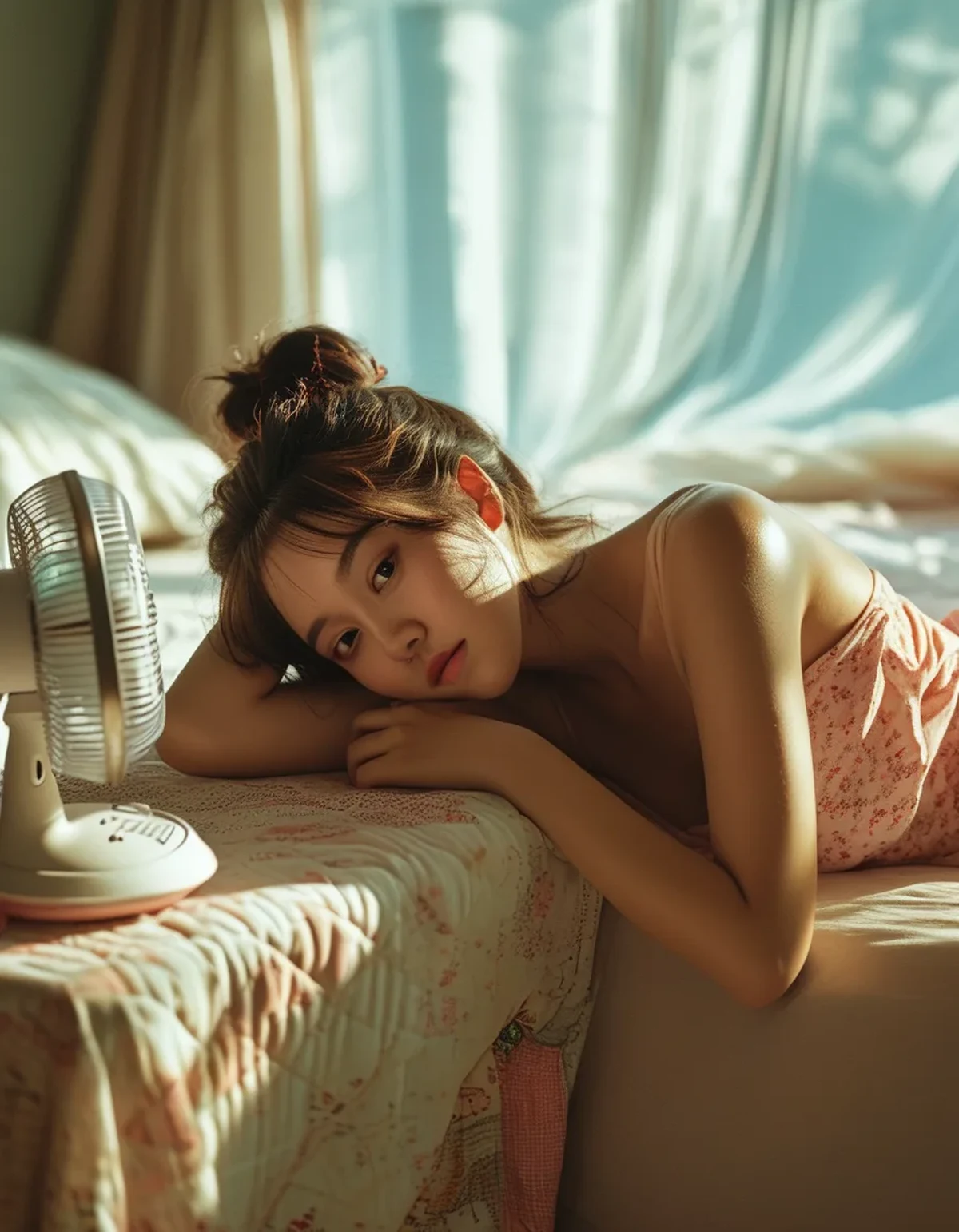
Does white noise from the fan matter more than the airflow?
For some people it matters more, and it is worth knowing which type you are.
Broadband noise masks the sounds that wake you. Sleep is disrupted less by steady loud sound than by sudden changes in sound - a door, a car, a creak. A fan raises the background level so those changes are smaller relative to the baseline, and smaller changes are less likely to pull you out of light sleep.
That masking effect works even in a cold room. If you use a fan in October and still sleep better, you are probably using it as a sound machine and can stop fighting the temperature question entirely.
The easy test: run the fan facing away from the bed for three nights. If sleep stays good, you need the noise. If it degrades, you need the air. If both help, you need both - and a fan is a very efficient way to get them from one device.
A dedicated sound machine is quieter per decibel of useful masking. Fan noise includes a mechanical hum that some people find intrusive at low volumes, and a purpose-built white noise source usually sounds smoother.
Volume matters more than most people assume. Keep masking sound at conversation level or below - loud enough to blur the door slamming, quiet enough that you would still hear a smoke alarm.
Myth vs Fact: Sleeping With a Fan On
Myth: A fan cools your bedroom. Fact: it warms it very slightly. The motor converts electricity into air movement and waste heat, so a fan running in an empty sealed room raises the temperature a fraction of a degree. It only helps when there is a person in the room to cool.
Myth: Sleeping with a fan on makes you sick. Fact: moving air does not cause infection, but it does dry mucous membranes and can dry your eyes if you sleep with them slightly open. The morning sore throat is dehydration of the tissue, not a virus.
Myth: A ceiling fan should run the same direction all year. Fact: it should reverse. Counterclockwise pushes air down for a cooling breeze in summer; clockwise pulls air up and gently redistributes warm ceiling air in winter without a draught.
Myth: Faster is always better. Fact: past a certain point, extra speed adds noise and dryness without adding much cooling. Most people over-run their fan and would sleep better a setting lower.
Myth: If you are still hot, you need a bigger fan. Fact: you may need less bedding. A fan cannot cool through a duvet, and a lighter cover with the same fan often outperforms a stronger fan with the same duvet.
Myth: A fan is a poor substitute for air conditioning. Fact: for sleep specifically, it addresses the same bottleneck - your body’s heat loss - and it does it for a fraction of the running cost. Air conditioning wins in genuinely hot, humid conditions; a fan wins on value everywhere else.
FAQ: Fans and Sleep, Answered
Is it bad to sleep with a fan on every night?
For most people it is fine. The two real downsides are dryness - of eyes, nose, and throat - and dust circulation, which matters if you have allergies. Keep the fan blades clean, aim it across the bed rather than at your face, and keep water nearby.
Why do I wake up with a stuffy nose after using a fan?
Dry air makes nasal tissue swell as it tries to humidify what you are breathing, which feels like congestion. It also stirs up settled dust. Try a lower speed, an indirect angle, and cleaning the blades - dust builds up on them faster than people expect.
Should I run a fan in a room that is already cool?
Only if you want the noise. Below roughly 65F, the airflow is more likely to cause a chilled shoulder or a stiff neck than to help you sleep. In that case turn the fan away from the bed and keep it purely as a sound source.
TL;DR:
- A fan does not cool the room - it speeds up how fast your body sheds heat, which is what actually matters for falling asleep.
- Air has to reach skin. A fan pointed at a duvet is doing almost nothing.
- Aim across the bed at chest height, oscillating, and keep hands and feet uncovered.
- Some of the benefit is the noise, not the air - test by facing it away for three nights.
- Dryness, not illness, causes the morning sore throat. Lower speed, indirect angle, clean blades.
Tonight, try one speed lower and one blanket lighter. It is the combination almost nobody tests, and it usually wins.
Keep Reading
This article is for general informational purposes only and is not medical advice. Always consult a qualified health professional for guidance specific to you.