Does Eating Late Actually Ruin Your Sleep?
Quick Answer: Late eating does measurably affect sleep, but the timing rule most people repeat is too blunt. A large or high-fat meal within about 2 hours of bed reliably worsens sleep quality — more reflux, higher core temperature, more nighttime awakenings. A small, protein- or carbohydrate-based snack in that same window usually does not, and for some people it improves sleep by preventing an overnight blood sugar dip.
You eat dinner at 9pm because that is when you get home, and somewhere in the back of your head is a voice repeating that you should have stopped eating at 7.
The voice is not wrong, exactly. It is just working from a rule that flattens a lot of nuance. The size and composition of the meal matter more than the clock does — and the third factor below is the one that explains why the same 10pm snack helps some people and wrecks others.

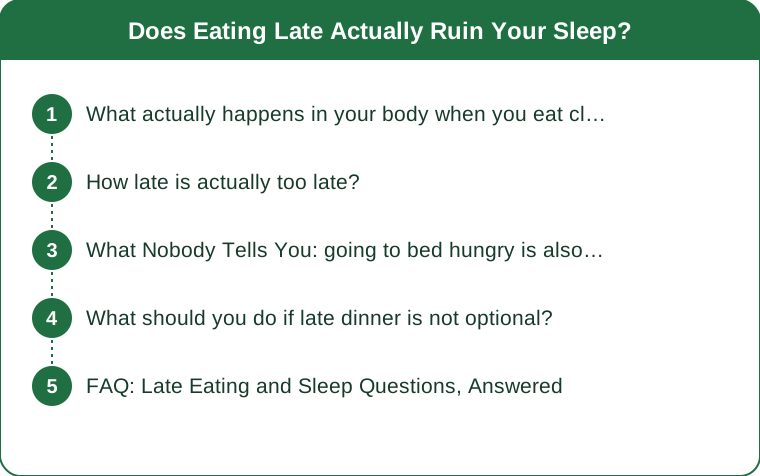
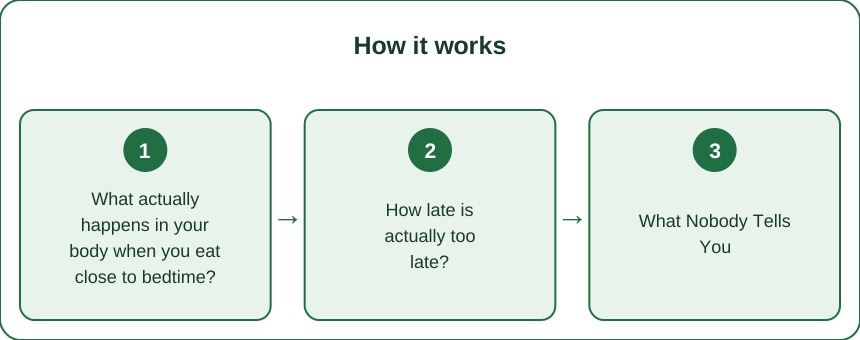
What actually happens in your body when you eat close to bedtime?
Three things, all of which run against sleep.
First, digestion raises core body temperature, and falling asleep depends on core temperature dropping. A substantial meal keeps your metabolic rate elevated for a couple of hours, which pushes back the temperature decline your brain is waiting for.
Second, lying down within an hour or two of a full stomach makes reflux far more likely — and reflux causes brief awakenings you often will not remember, only feel the next morning.
Third, and least appreciated: eating is a signal to your circadian system. Your liver, pancreas, and gut run their own clocks, and they take their cues from meal timing rather than light. Eating at wildly different times each night keeps those peripheral clocks out of sync with your brain clock, which shows up as poorer sleep quality even when total sleep time looks fine.
How late is actually too late?
For a full meal, roughly 2 to 3 hours before bed is where the evidence lands. Studies looking at meals eaten within an hour of sleep consistently show more time awake after falling asleep and less deep sleep in the first half of the night.
But the number that matters more is the size. A 700-calorie dinner at 9pm and a 150-calorie snack at 9pm are not the same event. The snack is largely invisible to your sleep architecture; the dinner is not.
Fat content is the single biggest predictor. High-fat meals empty from the stomach slowly — sometimes four hours or more — which extends every problem above. High-carbohydrate meals empty fastest, and there is reasonable evidence that a modest carbohydrate-containing snack an hour before bed can shorten the time it takes to fall asleep.
Alcohol deserves its own line. It is not food, it reliably makes you fall asleep faster, and it just as reliably fragments the second half of your night. If you are auditing your evening intake, that is the first thing to look at, not the timing of your rice.

What Nobody Tells You: going to bed hungry is also a problem
The advice to stop eating early assumes the alternative is neutral. For a meaningful number of people, it is not.
If you finish dinner at 6pm and go to bed at 11pm, that is a five-hour gap, and by 3am you are somewhere around nine hours into a fast. For people who are lean, very active, or eating in a calorie deficit, that is enough for blood glucose to drop far enough to trigger a cortisol and adrenaline response — which is one of the more common reasons for waking up wired at 3am with no obvious cause.
The tell is straightforward: if you wake in the small hours feeling alert rather than groggy, sometimes with a racing heart, and you go back to sleep quickly after eating something, hunger is a plausible driver.
The fix is not a bigger dinner. It is a small, mixed snack — around 150 to 200 calories with some protein and some slow carbohydrate — about an hour before bed. Greek yogurt with a spoonful of oats. A slice of toast with nut butter. Cottage cheese and a few berries. It is small enough not to load the stomach and substantial enough to hold glucose through the night.
The other thing nobody mentions: consistency beats optimization. Eating at wildly different times every night is worse for sleep than eating slightly late but at the same time every night.
What should you do if late dinner is not optional?
Plenty of people finish work at 8 or 9. The rule is not going to fit, so adjust the variables you control.
Shift the balance of the day. Make lunch the largest meal and the late dinner the smallest. Same total food, much less of it sitting in your stomach at bedtime.
Change the composition, not just the size. Lean protein and vegetables with a moderate portion of carbohydrate leaves the stomach far faster than something fried or heavily sauced. Save the high-fat meals for weekends when you eat earlier.
Stay upright for 60 to 90 minutes after eating. Not exercising — just not horizontal. This single habit does more for reflux-related awakenings than any timing rule.
Sleep on your left side, and raise the head of the bed slightly if reflux is a recurring issue. Both are well established for reducing nighttime acid exposure.
Push bedtime back 30 minutes rather than eating faster. If dinner lands at 9, sleeping at 11:30 instead of 11 costs you very little and gives digestion a real head start.
If you are dealing with persistent reflux, ongoing insomnia, or unexplained night waking, that is worth a conversation with your doctor rather than a schedule tweak. This is general information, not medical advice.
FAQ: Late Eating and Sleep Questions, Answered
Does eating late make you gain weight?
Mostly indirectly. Total intake is what drives weight change, but late eating tends to correlate with larger portions, more snacking, and less appetite regulation the next day because of the sleep disruption. The timing itself is a smaller factor than the pattern it usually comes packaged with.
Is a glass of milk before bed actually useful?
Somewhat, and probably not for the reason you have heard. The tryptophan content is too small to matter meaningfully on its own. What likely helps is that it is a small mixed protein-and-carbohydrate snack that steadies overnight glucose — which is the same reason yogurt or toast works.
What about caffeine timing rather than food?
Bigger lever than dinner for most people. Caffeine has a half-life of roughly five to six hours, meaning a 3pm coffee still has a quarter of its dose in your system at 11pm. If you are auditing your evening for sleep saboteurs, start there and work backwards.
TL;DR:
- A large or high-fat meal within 2 hours of bed genuinely worsens sleep; a small mixed snack usually does not.
- Fat content and portion size predict the disruption better than the clock does.
- Going to bed hungry causes its own 3am awakenings — a 150-calorie protein-plus-carb snack often fixes them.
- If dinner has to be late, shrink it, keep it lean, stay upright for an hour, and push bedtime back 30 minutes.
The useful version of the rule is not stop eating at 7. It is eat your largest meal earlier, keep whatever lands late small and simple, and do it at roughly the same time every night. Your gut clock cares about consistency far more than it cares about the number on the oven.
Keep Reading
This article is for general informational purposes only and is not medical advice. Always consult a qualified health professional for guidance specific to you.