How to Actually Sleep Better: The Complete Guide for Tired Women
Sleep is the health habit all other health habits report to: it regulates the hormones that manage hunger, mood, focus and recovery, and no supplement stack compensates for its absence. Women draw a particularly rough hand — hormonal shifts, mental-load insomnia, the 3am ceiling stare — and most sleep advice stops at avoid screens. Let us go properly deeper: the anchors, the wind-down, the bedroom physics, and the 3am protocol. (General guidance — persistent sleep problems deserve a real clinician.)

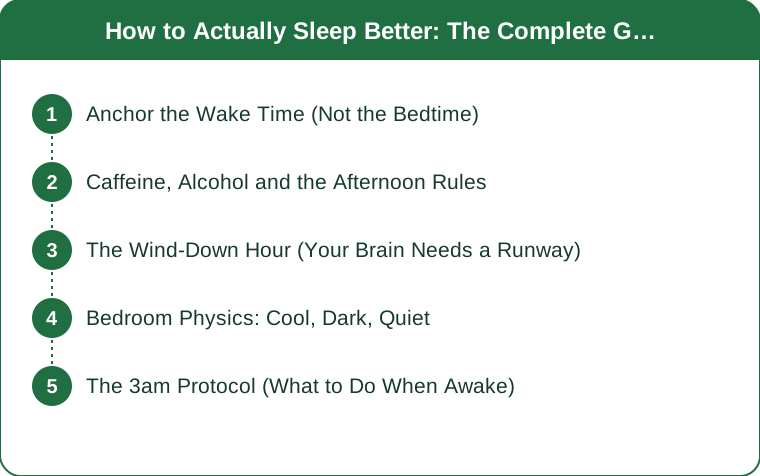
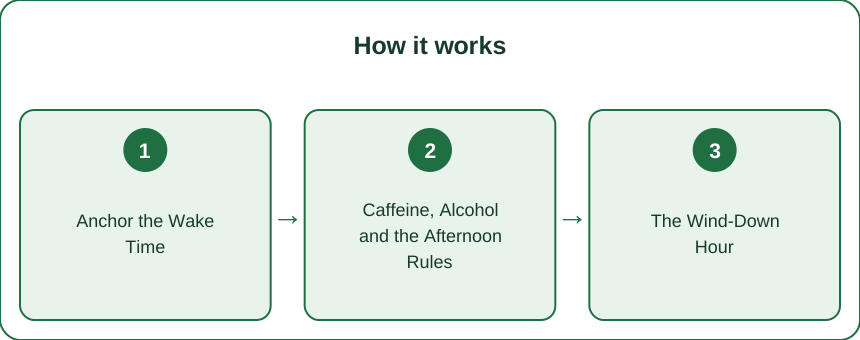
Anchor the Wake Time (Not the Bedtime)
Counterintuitive but foundational: the most powerful sleep lever is a consistent wake time, seven days a week — it sets your circadian clock, which then makes you reliably sleepy at the right hour that night. Sleeping in three extra weekend hours feels like repayment but functions as jet lag, which is why Monday nights are so often insomnia nights. Pair the fixed wake time with morning light within an hour of rising — ten minutes outside beats every lightbulb you own — and you have installed the two anchors the whole system hangs on.
Caffeine, Alcohol and the Afternoon Rules
The pharmacology portion, briefly: caffeine’s half-life runs five to six hours, so the 3pm latte is still 25% on duty at 9pm — cut caffeine by early afternoon, earlier if you are a sensitive metabolizer (you know who you are). Alcohol is sleep’s most successful impostor: it sedates you into sleep, then fragments the back half of the night and suppresses REM — the nightcap is borrowing sleepiness at a brutal interest rate. And exercise remains a genuine sleep drug, timed anywhere except the final two hours before bed for most people. Three rules, decades of evidence, zero purchases.
The Wind-Down Hour (Your Brain Needs a Runway)
You cannot slam a busy brain from sixty to sleep — it needs descent. The final hour before bed, run a repeatable landing pattern: lights dimmed house-wide (bright overhead light at 10pm reads as noon to your clock), screens down or at least distanced and dimmed (the content stimulates more than the blue light does), and a sequence your brain learns to read as sleep approaching — shower, skincare, stretching, pages of a paper book, tomorrow’s to-list dumped onto paper so your mind stops rehearsing it. Boring is the objective. Boring is the runway.
Bedroom Physics: Cool, Dark, Quiet
Your body needs a slight core-temperature drop to initiate sleep, which makes the bedroom thermostat a sleep tool: 18–19°C (65–67°F) is the research sweet spot — in summer, fans and breathable bedding are performance equipment. Darkness matters more than people credit (even dim light measurably degrades sleep quality — blackout curtains or a contoured mask), and noise consistency beats silence (white noise smooths the spikes that jolt light sleepers). One honest audit of the room — light leaks, heat, that streetlight — is worth a month of supplements.
The 3am Protocol (What to Do When Awake)
First, calibration: brief night wakings are architecturally normal — the failure is the spiraling. The protocol when you cannot resettle within twenty-ish minutes: leave the bed (the bed must stay associated with sleep, not with lying awake auditing your life), keep lights low, do something profoundly boring — dull book, slow breathing on the couch — until genuinely sleepy, then return. Never check the clock (the 3:47am math is a stress hormone dispenser) and never open the phone. If most nights run this script for weeks, that is a clinician conversation — persistent insomnia and issues like sleep apnea in women are underdiagnosed and very treatable.
Better sleep is systems work, not luck: anchor the wake time, respect the caffeine curfew, fly the wind-down descent, chill the room, and run the 3am protocol instead of the 3am spiral. Install the anchors this week — fixed wake time, morning light — and let the rest stack on top. Every other goal you are chasing gets easier when this one works. Sleep is not the reward for a productive life. It is the fuel.
Keep Reading
This article is for general informational purposes only and is not medical advice. Always consult a qualified health professional for guidance specific to you.