Why You Wake Up Groggier Some Mornings Even With the Same Sleep Hours
Quick Answer: Grogginess usually comes from waking mid-deep-sleep cycle, not from total sleep hours — timing your alarm to a lighter sleep stage fixes it more reliably than sleeping longer.
Seven hours one night leaves you sharp. Seven hours the next leaves you dragging through the whole morning. The difference isn’t the hours — it’s the moment your alarm caught you.

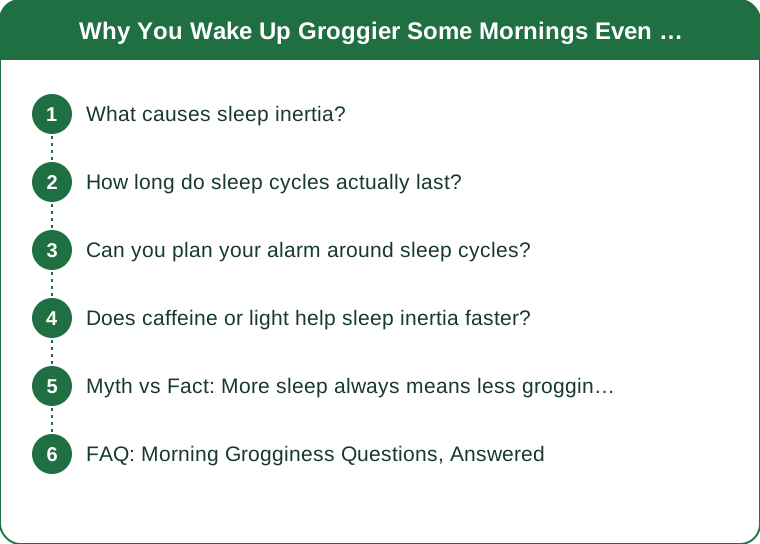
What causes sleep inertia?
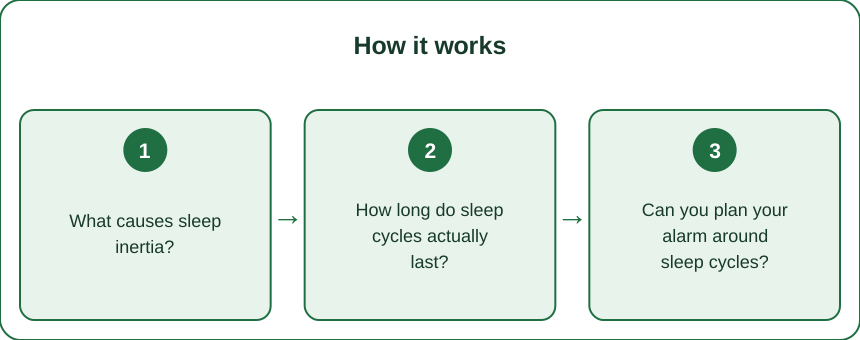
Sleep inertia is the grogginess that happens when you wake during deep, slow-wave sleep instead of a lighter stage. Your brain hasn’t finished the transition out of deep sleep, so cognitive function and alertness lag behind for anywhere from a few minutes to over an hour, even though your total sleep time was perfectly adequate.
How long do sleep cycles actually last?
A full sleep cycle runs roughly 90 minutes, moving through light sleep, deep sleep, and REM before starting over. Waking up at the end of a complete cycle (during light sleep) feels dramatically easier than waking in the middle of a deep-sleep phase, which is why sleep quality can vary so much even with the same total hours logged.
Can you plan your alarm around sleep cycles?
Yes, roughly — if you know your average bedtime, setting an alarm for a multiple of 90 minutes after sleep onset (accounting for the 10-20 minutes it typically takes to fall asleep) increases the odds of waking during a lighter stage. It’s not exact since individual cycle length varies, but it’s a far better strategy than picking a wake time purely based on total hours.

Does caffeine or light help sleep inertia faster?
Light exposure, especially natural daylight, is the more reliable fix — it suppresses melatonin and signals your circadian clock that the day has started, speeding the transition out of grogginess. Caffeine helps too, but it takes 20-30 minutes to take effect and doesn’t address the underlying sleep-stage mismatch the way morning light does.
Myth vs Fact: More sleep always means less grogginess
Myth: if you’re groggy, you just didn’t sleep enough. Fact: it’s entirely possible to feel worse after 8 hours that ended mid-deep-sleep than after 6.5 hours that ended in a light stage — total duration and wake timing are two separate variables, and timing is often the one people ignore.
FAQ: Morning Grogginess Questions, Answered
Is sleep inertia the same as being sleep deprived?
No — sleep deprivation is a total-hours problem, while sleep inertia is a timing problem that can happen even after a full night’s sleep.
Do sleep tracking apps accurately predict light-sleep wake windows?
Most consumer trackers estimate sleep stages from movement and heart rate, which is reasonably useful but not lab-accurate, so treat their wake-window suggestions as a helpful guide rather than a guarantee.
Why do naps sometimes leave me groggier than no nap at all?
A nap that runs long enough to hit deep sleep (usually past 30 minutes) creates the same mid-cycle wake-up problem as a poorly timed morning alarm.
TL;DR:
- Grogginess is often about when in your sleep cycle you wake, not how long you slept
- Sleep cycles run about 90 minutes each
- Timing your alarm to a cycle multiple can reduce grogginess
- Morning light works faster than caffeine to clear sleep inertia
Next time a full night’s sleep still leaves you dragging, check your wake time against 90-minute cycles before assuming you just need more hours.
Keep Reading
This article is for general informational purposes only and is not medical advice. Always consult a qualified health professional for guidance specific to you.