Social Jetlag: How Weekend Sleep Schedules Give You Monday Jetlag Without Leaving Town
Quick Answer: Sleeping 2-3 hours later on weekends shifts your circadian clock the way flying two time zones west does — then Monday’s alarm demands an instant flight back, and the grogginess, 3pm crash, and Sunday-night insomnia are literal jetlag symptoms. The fix isn’t puritan weekends: cap the sleep-in at 1 hour past your weekday wake time, bank extra sleep with earlier bedtimes instead, keep morning light consistent, and accept that Monday-you is the client every weekend decision serves. This is general information, not medical advice.
Monday tiredness has a dozen suspects — the week ahead, the meetings, the existential Sunday dread. The overlooked one is arithmetic: Friday 1am + Sunday 10:30am wake = your body clock genuinely relocated westward for the weekend, and Monday’s 6:45 alarm is an international arrival nobody booked.

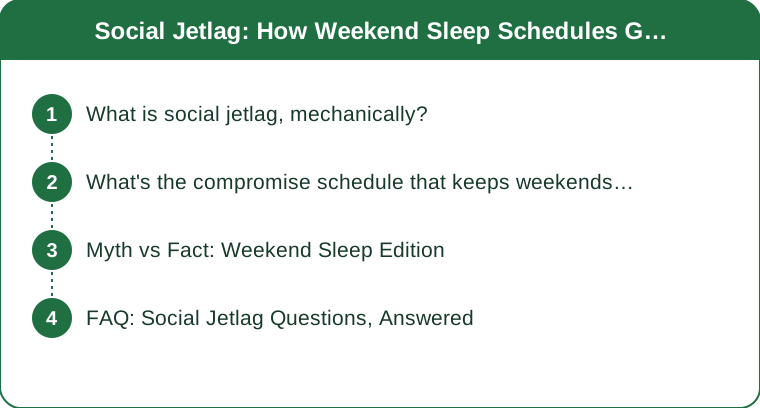
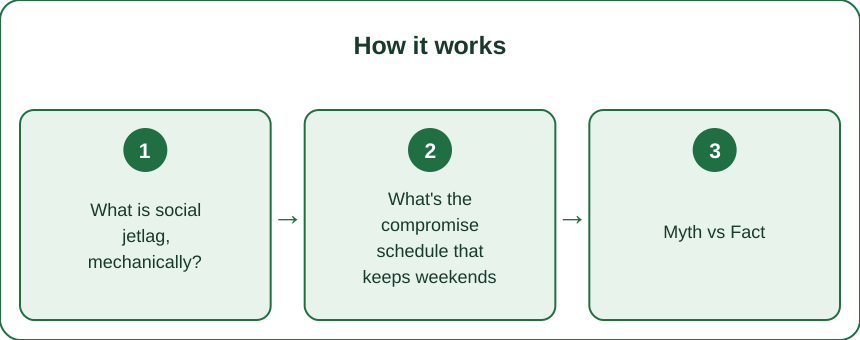
What is social jetlag, mechanically?
The term from chronobiology research: the mismatch between your social clock (alarms, work) and your biological clock (circadian rhythm) — measured as the difference between your sleep midpoint on free days versus work days. A weekday midnight-to-6:45 sleeper whose weekend runs 2am-to-10:30 has shifted their sleep midpoint by ~2.5 hours — functionally a Friday flight from Seoul to somewhere over the Indian Ocean, returning Monday at dawn.
Why the clock actually moves: sleep timing plus morning light timing are the circadian system’s main setters — waking at 10:30 means light hitting your eyes 3+ hours late, which the clock reads as ‘we’ve moved west’ and adjusts accordingly. By Sunday night the adjusted clock isn’t ready for sleep at your weekday bedtime (hello, Sunday insomnia — it’s not just dread; it’s time zones), and Monday morning it’s being woken at what it now considers ~4:30am.
The research picture: larger habitual social jetlag associates with worse mood, performance, and metabolic markers across studies — the body treats chronic weekly clock-shifting as exactly the stressor frequent-flyer physiology suggests. The Monday feeling was never a character flaw; it was a boarding pass.
What’s the compromise schedule that keeps weekends human?
The rules that preserve both the clock and the fun:
- The 1-hour cap: weekend wake time within ~60 minutes of weekday wake — the shift small enough that Monday requires no re-entry. (The research-adjacent rule of thumb: clock disruption scales with the shift size; one hour is a rounding error, three is a flight.)
- Bank sleep at the front, not the back: the Friday/Saturday recovery sleep you legitimately need comes from earlier bedtimes, not later mornings — 11pm-to-8am delivers nine hours with a clock-friendly wake. Sleeping-in feels like the reward, but bedtime is where the debt actually gets repaid without interest.
- Keep the morning light appointment: whenever you wake, get outside light within an hour — the weekend’s most protective single habit, anchoring the clock even when timing drifts.
- The nap escape valve: big Friday night? Wake near-schedule anyway, then take a 20-30 minute early-afternoon nap — debt serviced, clock untouched. (The 90-minute 4pm nap is the double-error: too long, too late.)
- Sunday night runs on Saturday’s choices: the Sunday-insomnia fix happens 24 hours earlier — Saturday’s wake time and light exposure decide whether Sunday’s 11pm feels like bedtime or mid-evening.
For the genuinely night-shifted (evening chronotypes): the strategy shifts from ‘fight your nature’ to ‘minimize the swing’ — a consistently late-ish schedule seven days a week beats an early-late-early sawtooth, if work allows any flexibility at all.

Myth vs Fact: Weekend Sleep Edition
Myth: Weekend lie-ins repay the week’s sleep debt. Fact: Partial repayment at clock-shifting interest — recovery sleep is real (the extra hours do help), but delivered via late mornings it simultaneously creates the Monday jetlag that starts next week in deficit. Early bedtimes deliver the same repayment without the currency exchange fee.
Myth: Everyone needs the same schedule discipline. Fact: Chronotypes are real and partly genetic — evening types suffer social jetlag worst (their biology fights weekday alarms all week, then weekend freedom swings them furthest). For them the advice reorders: minimizing the weekly swing matters more than achieving morning-person cosplay.
Myth: Sunday-night insomnia is anxiety about Monday. Fact: Often it’s both — but the circadian half is testable: weekends with capped wake times reliably shrink Sunday sleeplessness even when Monday’s meeting load doesn’t change. The dread gets blamed for what the time zones did.
The teenager footnote: adolescent clocks run biologically later — teen weekend sleep-ins are partly genuine catch-up for schedules that fight their chronotype, and the same 1-hour-cap advice applies more gently there. (Persistent exhaustion despite adequate opportunity, or sleep that never refreshes, is a clinician conversation at any age. This is general information, not medical advice.)
FAQ: Social Jetlag Questions, Answered
How fast does the clock actually shift on a weekend?
The circadian system can drift roughly an hour per day under shifted light and sleep — so a full weekend of 3-hour-late mornings genuinely relocates you 1.5-2 zones by Sunday night. (Shifting back runs slower and less comfortably — the asymmetry every eastbound traveler knows, replayed weekly.)
Is it better to stay up late but wake on time, or sleep early and wake early?
For the clock: wake time and its light anchor dominate — a late night with an on-schedule wake (plus a nap) disrupts less than a full late-shifted night. For total health: chronic short nights aren’t a strategy either; the sustainable answer is front-loading bedtime on the weekends you need recovery.
Does this apply if my weekend shift is only an hour?
An hour is within the noise the system handles gracefully — the research concern concentrates at 2+ hours of habitual midpoint shift. If you’re a one-hour drifter feeling fine on Mondays, your schedule already is the compromise version; this article was for your 3-hour friends.
TL;DR:
- Weekend sleep-ins shift your clock like westward flights — Monday grogginess and Sunday insomnia are literal jetlag
- The compromise: wake within 1 hour of weekday time, bank recovery via earlier bedtimes, morning light within an hour of waking
- Naps (20-30 min, early afternoon) service the debt without touching the clock
- Evening chronotypes: minimize the weekly swing rather than performing morning-person
The Monday feeling was never about Monday — it was the return flight from a trip your alarm never agreed to. This is general information, not medical advice.
Keep Reading
This article is for general informational purposes only and is not medical advice. Always consult a qualified health professional for guidance specific to you.