Why a 20 Minute Nap Helps and a 60 Minute One Ruins Your Evening
Quick Answer: Nap length decides which sleep stage you wake from, and that decides how you feel for the next hour. Around twenty minutes keeps you in light sleep, so you wake clear. Between about forty five and seventy five minutes, you are likely to surface out of deep slow wave sleep, which produces the heavy, disoriented grogginess called sleep inertia — and a nap that long, taken late, also drains the sleep pressure you needed for bedtime. Set the alarm for twenty five minutes or commit to a full ninety. The lengths in between are the problem.
It is not whether you nap. It is where the alarm lands.
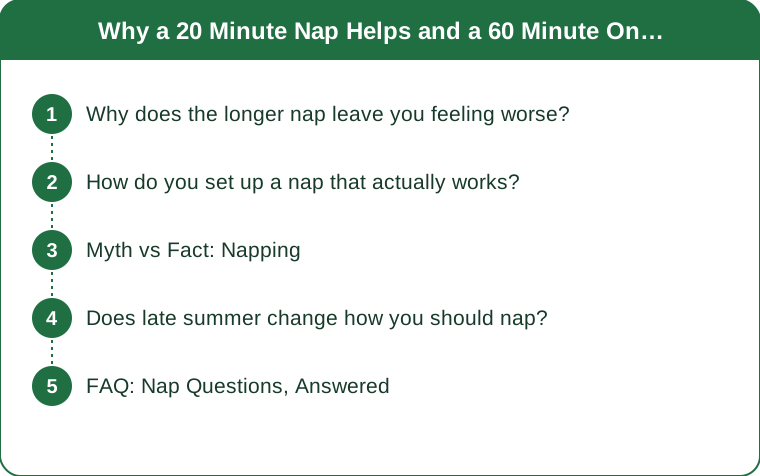
Why does the longer nap leave you feeling worse?
Because sleep is staged, and the stages are not interchangeable.
Within a few minutes of dozing off you enter light sleep, and waking from it is easy — this is why a short nap feels like a clean reset. But somewhere around the half hour mark, most people descend into slow wave sleep, the deepest stage, and an alarm that lands there drags you out mid process.
The result is sleep inertia: the heavy limbed, foggy, slightly grim state where you cannot remember why you thought napping was a good idea. Reaction time and decision making are measurably worse during it, and it can take anywhere from twenty minutes to over an hour to fully clear. For a lot of people the inertia costs more than the nap gave.
A full cycle runs roughly ninety minutes, which is why the other reliable nap length is the long one. Wake at the end of a complete cycle and you surface from light sleep again, usually feeling genuinely restored rather than resuscitated.
There is a second cost to the in between nap, and it is quieter. Deep sleep is where sleep pressure gets spent. The drive to sleep builds all day like an appetite, and an hour long nap at five in the afternoon eats a large portion of it. Bedtime arrives and you are simply not hungry for sleep, which is how one oversized nap unravels a whole night.
So the sixty minute nap fails twice: it wakes you from the worst possible stage, and it spends the pressure your night needed.
How do you set up a nap that actually works?
Pick a length on purpose, put it early, and stop treating falling asleep as part of the timed period.
Set the alarm for twenty five to thirty minutes, not twenty. It takes most people five to ten minutes to drift off, and the target is about twenty minutes of actual sleep. If you regularly fall asleep the moment you lie down, that is worth noticing — it usually means you are running a meaningful sleep debt.
Keep it before about 3pm. The later the nap, the more directly it competes with the night. Early afternoon sits in the natural post lunch dip, which is the easiest and least costly window. A nap at 5:30 is really a down payment on insomnia.
Do not fight for it. Lying rigidly still for forty minutes trying to force sleep is worse than resting with your eyes closed for fifteen. Quiet rest has genuine value on its own, and treating the nap as optional makes it easier to take.
Try the coffee nap if you need to be sharp afterward. Caffeine takes roughly twenty minutes to reach the brain, so a cup drunk immediately before a twenty minute nap has you waking just as it arrives. It sounds like a gimmick and it is surprisingly well supported.
Choose ninety only when the night allows it. A full cycle nap is a real tool after a terrible night or before a late obligation, but it needs a buffer — finish it by early afternoon or accept a later bedtime.
And give it a consistent place. A nap taken at a similar time, in a similar spot, with an eye mask and the phone out of reach, gets easier and more effective within a week.
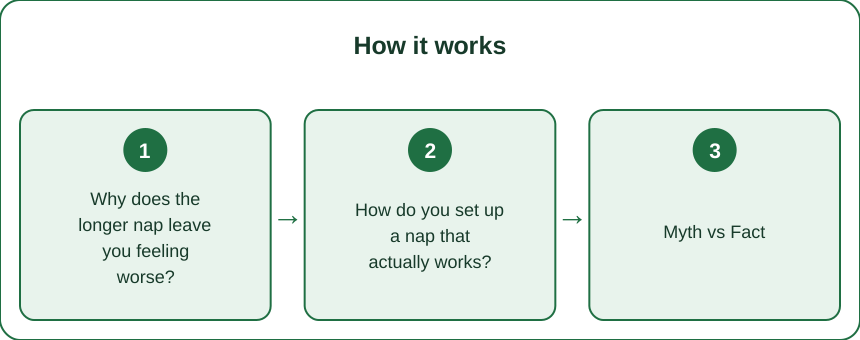
Myth vs Fact: Napping
Myth: needing a nap means your night sleep is failing. Fact: a dip in alertness in the early afternoon is built into the circadian rhythm and shows up even in people who slept a full night. Needing a nap every day to survive is worth examining. Wanting one occasionally is just being a mammal.
Myth: naps are for people who lack discipline. Fact: short naps improve alertness, mood, and reaction time in study after study, which is why pilots and shift workers are given protocols for them, not lectures about them.
Myth: if you cannot fall asleep, the nap failed. Fact: quiet rest with closed eyes lowers arousal and still helps. Measuring the nap by whether you lost consciousness sets a standard that makes the whole habit stressful.
Myth: naps always wreck night sleep. Fact: length and timing decide that. A twenty minute nap before mid afternoon barely touches the night for most people. An hour at 5pm is a different transaction entirely.
Myth: older adults should not nap. Fact: brief naps are fine at any age. What changes the calculus is nighttime insomnia — anyone struggling to sleep at night should protect every unit of sleep pressure for bedtime and skip naps while rebuilding the night.
Myth: grogginess after a nap means you needed even more sleep. Fact: it usually means the opposite — the alarm landed in deep sleep. The fix is a shorter nap, not a longer one.
Does late summer change how you should nap?
It does, in a few practical ways worth using while they last.
Hot nights are still degrading sleep right now, and August bedrooms that will not cool down leave a lot of people running a genuine sleep debt into their afternoons. A deliberate twenty minute nap is a better patch for that than a third coffee, and this is the season it earns its keep.
Nap where the heat is not. The couch in a west facing room at 3pm in August is a sweat trap, and body temperature needs to drop slightly for sleep to start. The coolest room in the house, a fan, and drawn blinds turn a doomed nap into an easy one.
The schedule shift arriving in September is the thing to plan around. Households moving back to school routines are about to lose the loose afternoons that made napping possible, and earlier alarms make afternoon dips deeper for a few weeks. If you know the dip is coming, a short scheduled nap — or even a planned ten minute eyes closed reset — beats fighting through it with snacks and scrolling.
Do not let the nap absorb the last of the evening light. The daylight after dinner is already shortening, and an evening walk does more for tonight than a 6pm doze ever will. If you are desperate to sleep at 6pm regularly, that is a signal about your nights, not your afternoons.
One honest caveat: if you are sleeping poorly night after night, naps are a patch and not a treatment. Persistent insomnia, loud snoring, gasping awake, or daytime sleepiness that affects driving are all reasons to talk to a doctor rather than to optimize the couch.
FAQ: Nap Questions, Answered
What is the single best nap length?
About twenty minutes of actual sleep, so an alarm set for twenty five to thirty from lying down. It refreshes alertness without entering deep sleep, which is what keeps the wake up clean.
Why do I wake up from naps with my heart racing and confused about the time?
That is classic sleep inertia from surfacing out of deep sleep, often with a dash of disorientation about light and time of day. Shorten the nap or extend it toward ninety minutes, and it largely disappears.
Is it better to nap or go to bed earlier?
For a chronic shortfall, earlier nights win — they deliver full cycles and protect the rhythm. Naps are best used as targeted patches for a bad night or a long day, not as the load bearing structure.
Can I train myself to take short naps?
Mostly, yes. Consistent timing, the same location, and an alarm you trust teach your body the shape of the thing within a week or two. The trust matters — half waking to check the clock is what keeps naps shallow and unsatisfying.
TL;DR:
- Twenty minutes wakes you from light sleep and feels clean; forty five to seventy five minutes risks waking from deep sleep into long grogginess.
- A full ninety minute cycle is the other good length, but it spends real sleep pressure, so keep it early and occasional.
- Nap before about 3pm, in a cool dark spot, with the alarm set for twenty five to thirty minutes.
- August sleep debt makes short naps genuinely useful right now — just do not let them eat the evening.
Next time you are tempted to just close your eyes for an hour, set the alarm for twenty five minutes instead. The version of you at 9pm will notice the difference.
Keep Reading
This article is for general informational purposes only and is not medical advice. Always consult a qualified health professional for guidance specific to you.