Why You Sleep Worse in a Hotel Even When the Bed Is Better
Quick Answer: The first night in an unfamiliar room triggers what researchers call the first-night effect: one hemisphere of your brain stays in lighter sleep and responds more strongly to unexpected sounds, acting as a night watchman. It is a survival adaptation, not a mattress problem. It fades by the second or third night, and you can shorten it by making the room feel predictable rather than comfortable.
The hotel bed is objectively nicer than yours. The pillows are better, the room is darker, and nobody’s alarm goes off at 5:40. You still wake up feeling like you slept about four hours.

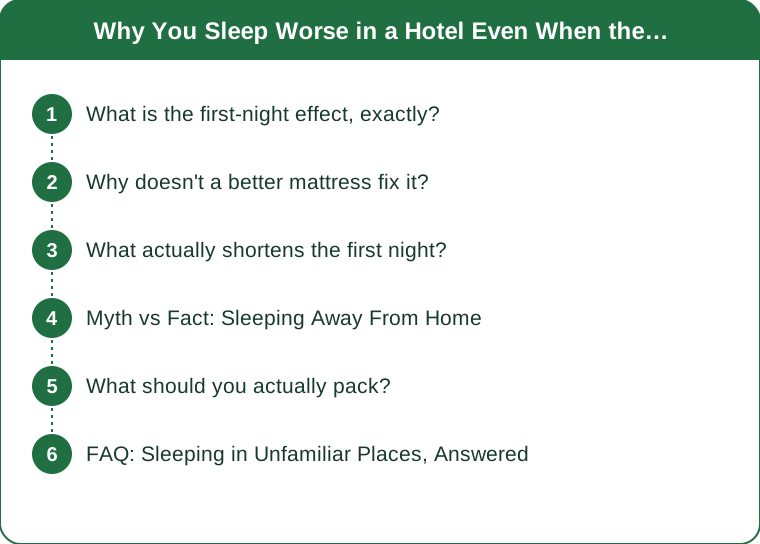
What is the first-night effect, exactly?
It is your brain deciding that an unknown room needs a guard.
Sleep researchers have measured this directly: on the first night in a new environment, one hemisphere of the brain shows lighter, shallower slow-wave sleep than the other, and that hemisphere reacts more strongly to unfamiliar sounds. The effect is asymmetric on purpose. Half of you sleeps; half of you keeps an ear open.
Marine mammals and many birds do a more extreme version of this all the time. Humans do a mild version only when the environment is new, which is the tell that it is about unfamiliarity rather than discomfort.
The practical consequences are consistent and annoying. You take longer to fall asleep, wake more often without remembering it, and get less deep sleep in the first half of the night — which is exactly the half that does most of the physical restoration.
And the crucial part: the quality of the bed has almost no influence on this. A luxury hotel triggers it. A friend’s spare room triggers it. Your own bed in a hotel-quiet room would not.
Why doesn’t a better mattress fix it?
Because comfort and safety are two different systems, and only one of them is asking a question.
Comfort is about pressure, temperature, and surface. Your body evaluates that in the first few minutes and then stops thinking about it. Safety is about predictability, and your brain keeps evaluating it all night — every sound it has not heard before gets processed rather than filtered.
This is why hotel sleep is so noise-sensitive. At home, the fridge cycling on, the pipes, the neighbor’s door — you have heard these thousands of times and your brain has learned to ignore them. In a hotel, every one of those sounds is novel, and novel sounds get a response even in sleep. The elevator, the ice machine, the hall door, the HVAC. None of them are loud. All of them are new.
The darkness of the room matters less than you would think for the same reason. Blackout curtains help with the light, but they do nothing about the fact that you do not know what is on the other side of the wall.
There is also a timing layer. Most hotel stays involve some travel, which means some circadian disruption, and even a one-hour shift is enough to make falling asleep harder. Add an unfamiliar dinner time and a later-than-usual arrival and the deck is stacked before you get to the room.
What actually shortens the first night?
Predictability beats luxury. Everything below is aimed at making the room boring to your nervous system.
Bring a continuous sound source. A fan, a white noise app, or the room’s own HVAC on a constant setting. This is the single highest-return fix, because it masks the novel intermittent sounds that trigger the response. Constant noise is ignorable; intermittent noise is not.
Bring one familiar object with a smell. Your own pillowcase is the classic and it works — scent is processed by a route with direct access to the emotional and memory systems, and a familiar smell reads as safe faster than anything visual.
Walk the room before bed. Open the closet, look behind the curtain, check the bathroom, note where the door is. It sounds silly, and it measurably shortens the settling period. You are giving your brain an answer to the question it will otherwise ask all night.
Keep your own timing. Same wind-down, same order, same rough hour, adjusted for the local clock. Habitual sequences are a strong sleep cue and they travel well.
Do not compensate with alcohol. A nightcap shortens the time to fall asleep and reliably worsens the second half of the night, which is already the part that survives the first-night effect best. You end up trading the good half for the bad one.
Book away from the elevator and the ice machine when you can, and request a high floor. This is the difference between a room with three novel sounds and a room with twelve.

Myth vs Fact: Sleeping Away From Home
Myth: You sleep badly in hotels because the bed is unfamiliar. Fact: The bed is barely a factor. The measured effect is about environmental novelty and sound, and it shows up in expensive hotels with excellent mattresses just as reliably as in cheap ones.
Myth: Frequent travelers do not experience it. Fact: They experience it less, and the reason is instructive. People who travel constantly tend to stay in similar rooms with similar layouts and similar sounds, so the environment stops being novel. It is familiarity with the category, not immunity.
Myth: If you are tired enough, it will not happen. Fact: Sleep pressure gets you to sleep faster but does not turn off the monitoring. You can fall asleep in four minutes and still get shallow, fragmented deep sleep.
Myth: The second night is always fine. Fact: Usually, and this is the reliable part — the effect largely resolves by night two and is mostly gone by night three. If night two is also bad, look at something else: caffeine timing, room temperature, or the fact that hotel rooms are often kept several degrees warmer than most people sleep well in.
Myth: Melatonin fixes it. Fact: Melatonin helps with circadian misalignment, which is a genuine and separate problem when you have crossed time zones. It does not address the monitoring response at all. If you are in the same time zone, it is treating a problem you do not have.
What should you actually pack?
A short list that handles most of it, weighing almost nothing.
The high-value four:
- Your own pillowcase, unwashed since your last night at home
- A white noise source, plus earplugs as a backup for the sounds it cannot mask
- An eye mask, since hotel curtains almost never close completely and the gap lands exactly where your head is
- A small clip or clothespin for that curtain gap, which is the cheapest sleep upgrade in travel
The temperature piece nobody plans for: most hotel rooms run warm, and the thermostat often has a floor around 66–68°F that it will not go below. Set it as low as it goes as soon as you check in, hours before bed, because these systems cool slowly and a room set at bedtime is still warm at 1am.
A note on the last hour. Do the same three things you do at home, in the same order, even if they are small — shower, read a few pages, lights down. The sequence is doing more work than any individual step, and it is one of the only cues you can carry with you intact.
And give yourself the actual expectation: the first night in a new place is usually a bad night, and that is normal rather than a sign something is wrong. Planning the important meeting or the long drive for day one, rather than day two, is a scheduling fix for a biology problem.
FAQ: Sleeping in Unfamiliar Places, Answered
Does this happen at a friend’s house too?
Yes, and often more strongly. A spare room in a house you do not know has all the novel-sound problems of a hotel plus social factors — you are less likely to get up and adjust the temperature or close a door, so small problems persist all night instead of getting fixed.
Why do I sleep fine on planes and badly in hotels?
Sleep on planes is usually so fragmented and short that you never reach the deep stages where the effect is measured, so there is nothing to disrupt. You are comparing a nap you had low expectations for against a full night you had high expectations for.
Should I take a sleep aid for the first night of a trip?
For an occasional important trip, that is a reasonable conversation to have with your doctor or pharmacist, particularly if jet lag is also involved. Routine use for ordinary travel tends to create its own problems, and the non-drug fixes above address the actual mechanism rather than sedating around it. This is general information, not medical advice.
TL;DR:
- The first night in a new room triggers a partial night-watchman response — one hemisphere sleeps lighter and reacts to unfamiliar sounds
- Mattress quality does not affect it; environmental novelty and intermittent noise do
- Mask sounds with something constant, bring your own pillowcase, walk the room before bed, and set the thermostat down at check-in
- Expect night one to be rough and schedule the demanding thing for day two
The good news is that this resolves itself. Your brain just needs one uneventful night of evidence that nothing in the room is going to come after you, and then it stands down.
Keep Reading
This article is for general informational purposes only and is not medical advice. Always consult a qualified health professional for guidance specific to you.