Why You Can Sleep 8 Hours and Still Wake Up Exhausted
Quick Answer: Waking up tired despite a full 8 hours usually points to sleep quality problems — fragmented sleep cycles, being woken mid-deep-sleep, or a mismatched wake time — rather than not enough total sleep. Duration is only half the equation.
You tracked it: a solid 8 hours, in bed on time, and you still woke up groggy and dragging through the morning. That’s a common and specific problem, not a sign you personally need more than 8 hours.

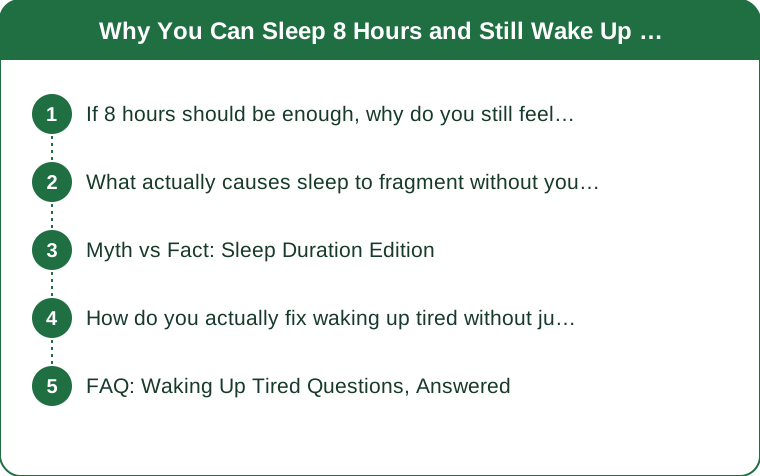
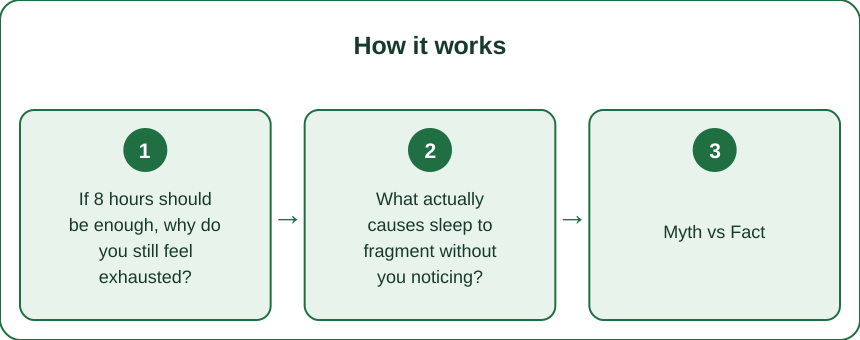
If 8 hours should be enough, why do you still feel exhausted?
Sleep happens in 90-minute cycles moving through light, deep, and REM stages, and waking up mid-cycle — especially during deep sleep — causes grogginess regardless of total hours. This is called sleep inertia, and it can make 8 hours interrupted at the wrong moment feel worse than 7.5 hours that ends cleanly at a cycle boundary.
Fragmented sleep (waking briefly multiple times, even without remembering it) also reduces how much deep and REM sleep you actually accumulate, even if your total time in bed looks fine on paper.
What actually causes sleep to fragment without you noticing?
Alcohol is one of the biggest silent culprits — it helps you fall asleep faster but fragments sleep in the second half of the night as it metabolizes, cutting deep sleep significantly even if you don’t wake up consciously.
A too-warm bedroom, screen light before bed, and inconsistent sleep/wake times all reduce sleep quality independent of duration. Your body relies on a stable internal clock — sleeping 8 hours at wildly different times each night undermines quality even when the hour count is identical.

Myth vs Fact: Sleep Duration Edition
Myth: everyone needs exactly 8 hours. Fact: the real range is 7-9 hours, and individual need varies — some people function well on 7, others genuinely need closer to 9.
Myth: sleeping in on weekends fixes a sleep debt. Fact: it helps somewhat but disrupts your circadian rhythm, often making Monday grogginess worse — a concept researchers call “social jet lag.”
Myth: waking up tired always means you need more sleep. Fact: it often means the sleep you got was lower quality, not insufficient in length.
How do you actually fix waking up tired without just sleeping longer?
Keep a consistent wake time every day, including weekends — this is the single highest-leverage change for sleep quality, since it stabilizes your circadian rhythm and makes each night’s sleep more efficient.
Cut alcohol and heavy meals within 3 hours of bed, keep the bedroom under 68°F, and get natural light exposure within 30 minutes of waking — this last one is underrated and helps reset your circadian clock daily, which improves the quality of sleep the following night.
FAQ: Waking Up Tired Questions, Answered
Could this be a sign of a sleep disorder?
If you’re consistently exhausted despite good sleep habits, snore heavily, or wake up gasping, it’s worth discussing with a doctor — could indicate sleep apnea or another disorder. This is general information, not medical advice.
Does napping help or hurt this problem?
A short nap (20-25 minutes) before 3pm can help alertness without disrupting nighttime sleep; longer or later naps often make nighttime sleep quality worse.
How long does it take to notice improvement from a consistent wake time?
Most people notice a difference within 1-2 weeks of holding a consistent wake time, even before other habits change.
TL;DR:
- Waking mid-sleep-cycle causes grogginess regardless of total hours slept
- Alcohol, inconsistent wake times, and a too-warm room fragment sleep quality silently
- A consistent wake time (including weekends) is the highest-leverage fix
- Persistent exhaustion despite good habits is worth a doctor conversation, not just more sleep
More hours in bed isn’t always the answer — protecting the quality of the hours you’re already getting usually is.
Keep Reading
This article is for general informational purposes only and is not medical advice. Always consult a qualified health professional for guidance specific to you.